International Speaker Media Kits — What US Templates Get Wrong for EU/UK Audiences
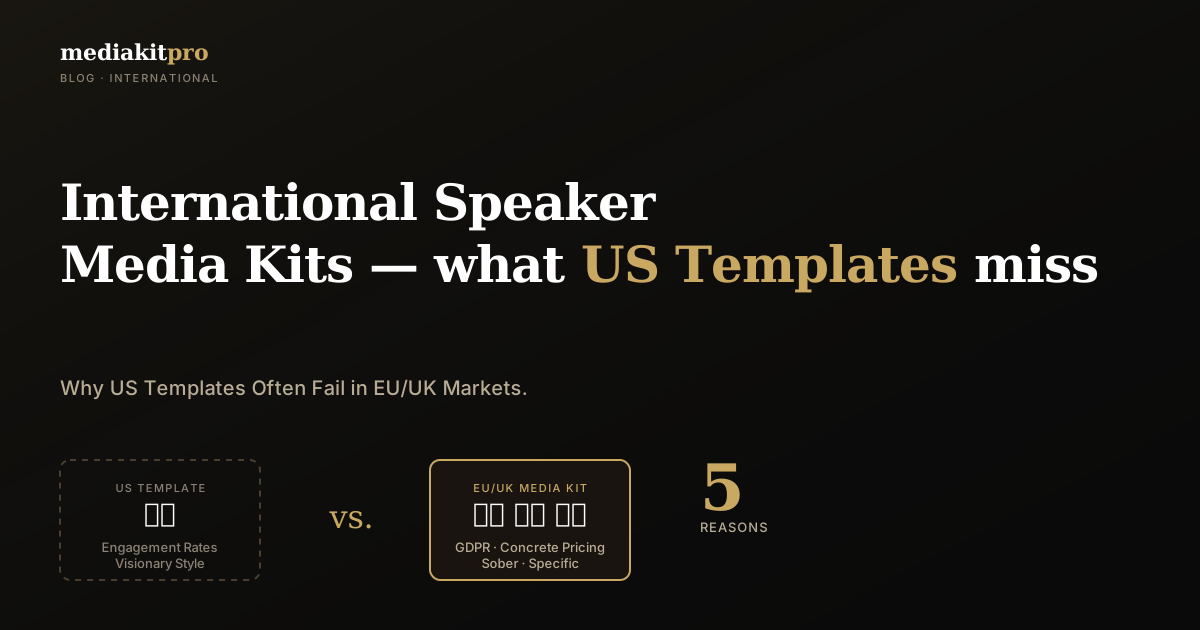
US media kit templates dominate Etsy and Creative Market. But do they work in EU and UK markets? Five concrete reasons US templates often fail across the Atlantic — and what works instead.
If you search "media kit template" on Google, you get 10,000+ results. 95 % are tailored to the US market. They look professional at first glance — and so many EU and UK speakers, coaches, and consultants think: "I'll just use one of these and adapt slightly."
This article shows you why this strategy often falls short. It's not just translation — it's about cultural expectations, legal requirements, and structural differences that are different in EU/UK markets than in the US.
Why US templates seem so attractive
Three reasons:
- Massive selection: Etsy, Creative Market, Envato — hundreds of designs in every style
- Very cheap: $5–25 per template (vs. $50–300 from EU specialists)
- High-quality look: US designers often have strong layout sensibility
These three factors are convincing — until you use the template in your market and realize something's off.
Reason 1: Structural expectations differ
US media kits for speakers are structured differently than EU/UK ones. Examples:
| Element | US convention | EU/UK convention |
|---|---|---|
| Engagement rates | Prominent (influencer logic) | Irrelevant for speakers |
| Pricing | Often "contact for pricing" | Range expected, otherwise distrust |
| Awards | Often inflated/created | Real industry/academic recognitions |
| Tone | Confident to grandiose | Sober, competent |
| Photo style | Heavily produced | Authentic, professional |
If you take a US template 1:1, you get a style that grates in EU/UK markets. Particularly self-elevation ("I am a Visionary World-Changing Thought Leader") feels damaging, not convincing, in the German, French, or Scandinavian markets.
UK is a partial exception — closer to US than continental Europe in tonality, but still less inflated.
Reason 2: Mandatory sections are missing or wrong
US templates don't know EU mandatory components. What's typically missing:
GDPR consent on inquiry forms
If your media kit has an inquiry form (it should), it must be GDPR-compliant:
- Consent checkbox before submit
- Clear info on what happens with the data
- Reference to privacy policy
US templates typically don't have this — they're built for CCPA (California) or nothing at all. For EU operators that's an actual legal risk.
Privacy policy link in footer
Mandatory in EU. In US templates often just "Privacy Policy" as placeholder.
Imprint (German: Impressum)
Legally required for any business website in Germany (DDG § 5). Less stringent in other EU countries but always trust-building. US templates don't have this. You need to add it manually with the right info:
- Name, address, phone, email
- VAT ID if applicable
- Person responsible for content
- Regulatory body if relevant
Cookie consent
EU cookie banner requirements are stricter than US. If your media kit uses tracking cookies, you need consent management. Most US templates don't include this.
Reason 3: Terms that don't translate
US templates use terms that either have no direct EU/UK equivalent or are connoted differently:
- "Speaking Fee" → Honorarium (UK), Speaking Fee (works), Honorar (DE) — translation OK
- "Coaching Package" → Coaching Programme (UK), Coaching-Paket (DE) — works
- "Engagement Rate" → For influencers OK, for speakers/coaches feels wrong — the audience either doesn't understand it or finds it ridiculous
- "Reach" → Audience Reach (UK), Reichweite (DE) — works
- "Press Kit" vs. "Media Kit" vs. "EPK" (Electronic Press Kit) — three terms for the same thing, used differently in different markets
The bigger issue isn't the translation but what the section contains. A US "Brand Partnerships" section, translated to "Markenkooperationen" in German, is out of place in a B2B consulting context. A corporate buyer thinks: "This is an influencer person, not a consultant."
Reason 4: Fee discussion runs differently
US speakers often communicate fees very confidently:
"Premium speaking fee starts at $50,000 and includes the following…"
In EU/UK markets that doesn't quite work. The consensus there is:
- Range is OK ("from £6,000")
- Concrete package prices are OK ("Keynote 45 min: $8,000")
- "Contact for pricing" is perceived as arrogant or evasive
- Very high premium pricing without explanation seems excessive
US templates reflect US fee logic. If you use them 1:1, you feel out-of-place in EU/UK contexts. More on pricing strategies in our coach media kit article.
Reason 5: Photo style differs
US speaker photos are often heavily staged: dramatic lighting, power pose, very produced look. In EU/UK markets this quickly feels artificial or self-important.
What works in EU/UK markets:
- Authentic headshots against neutral backgrounds
- Stage photos in action (real, not staged)
- Workshop settings with actual participants
- Portrait style more journalistic than "Hollywood"
If you use US templates, you often have photo slots designed too much for US style — oversized hero images, glamorous backgrounds. Even with good EU photos this can look kitschy.
Reason 6: Currency and pricing display
A subtle but important point: US templates default to $. If you do business in EU markets, you likely want € or £. Switching currency in a template is easy — but watching for currency-specific formatting is often missed:
- US: $5,000.00 (comma thousands, period decimal)
- DE: 5.000,00 € (period thousands, comma decimal)
- UK: £5,000.00 (similar to US)
If your template has hardcoded "$" and US-style number formatting, every fee in your media kit looks weirdly American to EU readers.
What works in the EU/UK market?
Three paths:
1. Use EU-specific templates
There's a small scene of EU/UK-specific media kit specialists (e.g., German design-template.de, UK-based templates from Envato). Pros:
- Mandatory sections like GDPR consent built in
- Local tonality and layout conventions
- GDPR-compliance mostly considered
- Personal support in local language
Cons: significantly more expensive than US templates ($50–300 vs. $5–25), smaller selection.
Detailed platform comparison: see our 10-platform review.
2. Build from scratch
With Canva or similar tools, design yourself for the EU/UK market. Pros: maximally individual. Cons: 4–8 hours of work for a usable result, many pitfalls. Complete Canva guide.
3. Use a EU/UK-aware SaaS tool
A platform specifically designed for EU/UK contexts. Pros:
- Mandatory sections pre-built (GDPR consent, privacy policy)
- EU/UK tonality and conventions considered
- Hosted in EU, GDPR-compliant
- Updates free
- Multilingual (EN + others for international bookings)
mediakitpro is exactly this — developed by an EU team for EU/UK speakers and coaches. Free plan costs $0, Pro plan $13/month. Live example.
What if you work internationally (US + EU)?
If you work in US AND internationally, you need a media kit that functions in both markets. Three strategies:
Strategy A: Two separate media kits
One for US, one for EU. Pro: each optimal for its market. Con: double maintenance.
Strategy B: Language toggle in one media kit
One platform, multiple languages, structurally identical but linguistically adapted. At mediakitpro Pro/Premium: 8 languages available (EN, DE, ES, FR, PT, IT, NL, PL) with automatic language toggle. Content gets maintained per language — you can adapt tonality per language.
Strategy C: Make-do with a US template translated for Europe
What most do. Rarely works. The reason for this article.
Conclusion
US media kit templates look tempting but often fall short in EU/UK markets for 5 structural reasons: different expectations, missing mandatory sections, wrong terms, different fee logic, different photo style.
If you want to be bookable in EU/UK markets, two reasonable paths exist:
- EU-specific template + manual adaptation
- EU-aware SaaS platform with EU market fit
For Option 2, mediakitpro is the direct suggestion — built in the EU for EU/UK markets, with all mandatory components pre-built, multilingual when you work internationally. Start free, no credit card.
What belongs in your EU media kit, see content checklist. Which specific mistakes happen most often in EU/UK markets, in the mistakes article. And how fast you can really build this — see the next post in this series.
On this page (20)
- Why US templates seem so attractive
- Reason 1: Structural expectations differ
- Reason 2: Mandatory sections are missing or wrong
- GDPR consent on inquiry forms
- Privacy policy link in footer
- Imprint (German: Impressum)
- Cookie consent
- Reason 3: Terms that don't translate
- Reason 4: Fee discussion runs differently
- Reason 5: Photo style differs
- Reason 6: Currency and pricing display
- What works in the EU/UK market?
- 1. Use EU-specific templates
- 2. Build from scratch
- 3. Use a EU/UK-aware SaaS tool
- What if you work internationally (US + EU)?
- Strategy A: Two separate media kits
- Strategy B: Language toggle in one media kit
- Strategy C: Make-do with a US template translated for Europe
- Conclusion
Visibility tips, delivered to your inbox
One actionable tip every 2 weeks for speakers, coaches and consultants. Unsubscribe anytime.
You might also like
ChatGPT for Media Kits — 12 Prompts That Actually Work
AI is the best tool right now for media kit content. 12 ready-to-use ChatGPT prompts to copy — for bio, speaking topics, testimonial polishing, and more. Plus the most common pitfalls.
Collecting Press Quotes & Testimonials — 7 Proven Strategies
A media kit without testimonials doesn't sell. But how do you get good quotes if you're not constantly in the media? 7 proven approaches — from elegant client outreach to conference feedback mining.
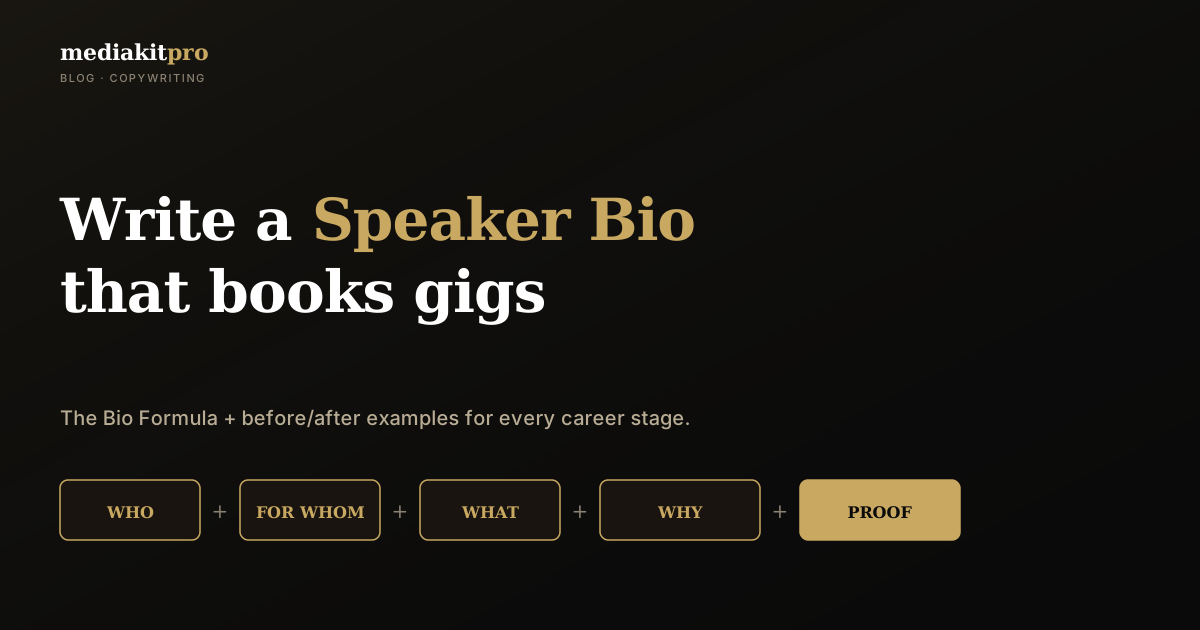
How to Write a Speaker Bio That Books Gigs (Templates Inside)
A strong speaker bio is the most important text in your media kit — and the one most people fumble. Here's the Bio Formula with before/after examples for every career stage.