ChatGPT for Media Kits — 12 Prompts That Actually Work
AI is the best tool right now for media kit content. 12 ready-to-use ChatGPT prompts to copy — for bio, speaking topics, testimonial polishing, and more. Plus the most common pitfalls.
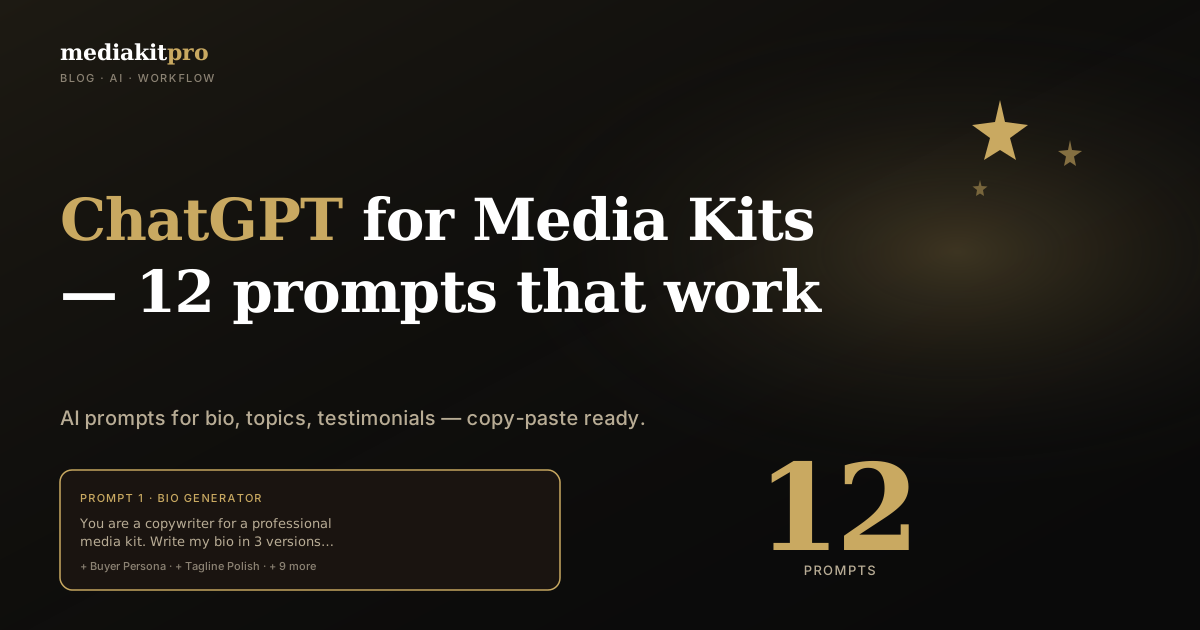
ChatGPT, Claude, and Perplexity are 2026's fastest tools for producing strong media kit content. Used right, you save hours — and often get better text than writing yourself.
This article shows you 12 ready-to-use prompts you can directly copy and use. Plus the typical pitfalls many fall into (e.g., "AI tells" that buyers immediately spot). By the end you have a complete AI workflow for your media kit.
What AI is good at — and what not — for media kit content
AI is excellent at:
- Writing bios in 5 length versions
- Distilling speaking topics from your expertise
- Polishing and smoothing testimonials
- Generating FAQ from your typical email replies
- Buyer personas and audience descriptions
- Translations into 8 languages with same tone
AI is bad at:
- Concrete numbers and references (can invent them — dangerous!)
- Very individual brand style (often sounds generic)
- Insider jargon of a specific industry
- Current market data (knowledge often outdated)
The rule: AI is your writing assistance, not your autopilot. Every output must be reviewed by you, corrected, and validated against real data.
The 12 prompts at a glance
| # | Prompt | Use case |
|---|---|---|
| 1 | Bio generator (3 lengths) | Speaker bio in short/medium/long |
| 2 | Speaking topics brainstorm | 10 talk titles from your expertise |
| 3 | Tagline polish | Distill the best tagline from 5 attempts |
| 4 | Testimonial polishing | Turn raw feedback into strong quotes |
| 5 | Organizer FAQ generator | 8 typical questions + answers |
| 6 | Package descriptions | Formulate coaching/workshop packages |
| 7 | "As seen in" texts | Brief media mention per appearance |
| 8 | Award/certificate descriptions | Brief, precise award texts |
| 9 | Translation helper | Adapt media kit content EN → DE/ES/FR |
| 10 | Buyer persona generator | Description of your ideal client |
| 11 | SEO meta description | Meta description for profile page |
| 12 | Social caption for media kit sharing | LinkedIn/Twitter captions to share |
All 12 prompts below to copy.
Prompt 1: Bio generator (3 lengths)
You are a copywriter for a professional media kit.
Write my speaker bio in 3 versions: short (50–80 words),
medium (120–180 words), long (250–400 words).

Use this Bio Formula: Who + Whom + What + Why + Proof.

Important rules:
- 3rd person ("Sarah Weber is…"), not 1st person
- No adjectives without substance ("passionate", "visionary")
- No resume elements ("studied X, worked at Y")
- Specific audience (not "companies", but "Fortune 500 boards")
- Concrete verbs (not "inspires", but "advises")
- At least 1 concrete proof point (number, bestseller, professorship)

Here are my data:
- Name: [YOUR NAME]
- Central role: [e.g., Speaker, Coach, Consultant]
- Concrete audience: [e.g., Fortune 500 boards, solopreneurs]
- What you concretely do: [e.g., advise on integrating AI into
  decision processes]
- Strongest proof: [e.g., 14 corporate projects, NYT bestseller,
  Harvard professorship]
- Optional: Awards, books, media presence

Write the 3 versions with focus on buyer clarity, not
self-elevation.
More on Bio Formula and before/after examples: speaker bio guide.
Prompt 2: Speaking topics brainstorm
You are a strategist for speaker positioning in the US/UK market.

Here is my expertise:
- [BULLET POINTS 5-10 LINES ABOUT YOUR EXPERTISE]
- Industries I'm active in: [INDUSTRIES]
- Typical clients: [AUDIENCE]
- Unique perspective / framework: [YOUR ANGLE]

Brainstorm 10 concrete talk titles.

Rules:
- Concrete (not "Leadership", but "AI Leadership 2030 — How
  Boards Use AI as Co-Pilot Without Outsourcing Authority")
- 8–15 words per title
- Buyer-relevant language (industry jargon allowed)
- Maximum sales trigger in title
- No buzzword festival

Output format: 10 talk titles + 1 sentence each on what it's
concretely about.
Prompt 3: Tagline polish
Three steps:
Step 1 (separate prompt):
Write me 8 versions of a tagline for my media kit.

Background: [AUDIENCE + CORE OFFERING IN 2-3 LINES]

Rules:
- Maximum 12-15 words
- Who + Whom + What must become clear
- No adjectives without substance
- No buzzwords
- Concrete verb instead of vague "inspires"

Step 2 (after the 8 versions):
Which of the 8 versions is strongest and why?
Rate by: clarity, buyer-relevance, differentiation.

Step 3:
Refine the best version: what can you make even more precise?
Prompt 4: Testimonial polishing
You polish raw client feedback into strong press quotes for
a media kit. Important: You don't change the CONTENT, only the
FORM.

Here's the raw feedback:
"[INSERT RAW FEEDBACK]"

Source: [Name of person, function, company — e.g.,
"Dr. Lisa Berger, CHRO Industry Corp"]

Polishing rules:
- Slow sentences down, cut repetitions
- Convert "you" to "[Name]" where it fits
- Make concrete outcomes prominent
- Maximum 3 sentences
- Preserve original tone (don't bureaucratize)

Output format:
1. Polished version (3 sentences max)
2. Note: what did you change?
3. Confirmation email template I can send to the original
   for approval of the polished version
More on collecting testimonials: 7 ways to collect strong quotes.
Prompt 5: Organizer FAQ generator
You build an FAQ section for my speaker media kit.

My activity: [ACTIVITY]
Format: [WHAT YOU BOOK: Keynote, Workshop, etc.]
Fee range: [YOUR RANGE]

Generate 8 questions organizers typically have — and answer
them from my perspective.

Required questions (at minimum):
1. What does a talk cost?
2. How long does a typical workshop run?
3. What technical setup is required?
4. Can you speak in English / other languages?
5. How are travel and accommodation arranged?
6. When should one inquire?

Plus 2 more questions fitting my specific activity.

Answer style:
- Concrete and short (3-5 sentences per answer)
- Factual, not promotional
- If data missing: insert placeholder [DATA], I'll fill in
Prompt 6: Package descriptions
You formulate package descriptions for my coaching/speaker media kit.

Here are my 3 packages:
- Package 1: [NAME, FORMAT, DURATION, PRICE]
- Package 2: [NAME, FORMAT, DURATION, PRICE]
- Package 3: [NAME, FORMAT, DURATION, PRICE]

Write 2-3 sentences per package:
- What's included (prep call, materials, follow-up)
- What concrete outcome to expect
- For whom the package is suited

Tone: factual, precise, no marketing-speak.
Maximum 60 words per package.
Prompt 7: "As seen in" brief texts
I've been a guest in the following media:
[LIST OF MEDIA APPEARANCES: outlet, magazine, podcast — per
appearance: date, format, topic]

Write per appearance a brief media kit entry (max. 25 words)
that clearly describes the format and topic.

Example format:
"NPR Morning Edition, Nov 12, 2024 — 10-min studio interview
on the AI roadmap of US tech firms."
Prompt 8: Award/certificate descriptions
Here are my certifications / awards:
[LIST: title, issuing institution, year]

Write per entry a media-kit-suitable brief text (max 30 words):
- What the certification proves (relevant to buyers)
- Who the issuer is (reputation)
- Optional: How you concretely use it in coaching/speaking

Tone: factual, not boastful.
Prompt 9: Translation helper
Translate this media kit text from English to [TARGET LANGUAGE: DE/ES/FR/etc.]

Important:
- Preserve the tone (factual-professional, "you" form where it fits)
- Adapt culturally, not literally
  (e.g., "Fees on request" → "Honorar auf Anfrage" doesn't work
  in German market — there usually "Honorar ab X €")
- Industry terms in target-language convention ("Fortune 500" stays
  Fortune 500, "board" becomes "Vorstand" in DE business context)
- For legal terms ("Imprint", "GDPR"): don't translate, explain
  ("Impressum per German DDG § 5")

Here's the text:
[INSERT YOUR MEDIA KIT TEXT]
More on multilingual media kits: International speaker media kits.
Prompt 10: Buyer persona generator
You build a buyer persona for my ideal audience — so I can
tailor my media kit to it.

My activity: [ACTIVITY]
Best clients so far: [3-5 DESCRIPTIONS]

Create a buyer persona with:
- Demographic data (age, function, industry, company size)
- What problem does the person have right now?
- What alternatives is she still evaluating?
- What must she see on a media kit to inquire?
- What language does she speak (buzzwords / jargon)?
- What typical objections does she have?

Output format: structured with clear hierarchy.
This persona you can then use to align your entire media kit setup — tagline, bio tone, packages, FAQ.
Prompt 11: SEO meta description
Write SEO title and meta description for my speaker media kit
profile.

Here's my profile:
- Name: [NAME]
- Central activity: [ACTIVITY]
- Main topics: [3 CORE TOPICS]

Output:
- SEO title: 55-60 characters
- Meta description: 150-160 characters

Include keywords but naturally. No keyword stuffing.
Buyer-relevant (organizers searching for speakers).
Prompt 12: Social caption for media kit sharing
You write a LinkedIn / Twitter caption to share my media kit
(e.g., after an update).

My media kit URL: [URL]
Current trigger: [e.g., "New book published", "Update with
new talks", "First time online"]

Write 3 versions:
1. Short (LinkedIn single post, max 100 chars)
2. Medium (LinkedIn headline with brief text, ~200 chars)
3. Long (LinkedIn long post, 3-5 paragraphs)

Rules:
- No "self-promotion energy" ("I'm pleased to introduce…")
- Concrete and value-driven
- 1 clear call-to-action
- Hashtag suggestions (3-5 per version)
The 5 most common AI pitfalls
Pitfall 1: AI invents numbers and references
ChatGPT happily hallucinates numbers and sources. "According to a McKinsey study…" — the study often doesn't exist. Always verify: all numbers, statistics, named references must come from your real source.
Pitfall 2: AI tells
Classic AI phrases that buyers immediately spot as "AI-generated":
- "In today's fast-paced world…"
- "It's more important than ever that…"
- "Let's together step into a future where…"
- "Empower your stakeholders to transformative outcomes"
If you see such phrases: delete, rewrite.
Pitfall 3: Too generic outputs
"Write me a strong bio" produces generic bios. The more specific your prompt, the better the output. Give AI:
- Concrete data about you
- Examples of desired style
- Clear rules (max words, prohibitions)
Pitfall 4: Using AI as 1:1 translator
"Translate my bio into German" gets literally translated, culturally off. Instead use Prompt 9 with adaptation instructions.
Pitfall 5: Trusting AI output without checking
Never copy AI output 1:1 to your media kit. Always:
- Read
- Correct
- Add personal touch
- Validate real data
Which AI tool for what?
| Tool | Strength | Weakness |
|---|---|---|
| ChatGPT (GPT-5) | Structured texts, long outputs | Hallucinates numbers |
| Claude | Longer contexts, more precise tone | Slightly more reserved |
| Perplexity | Research with source attribution | Writes somewhat dry |
| DeepL Write | Nuances in target language | Only DE/EN |
| Grammarly | English grammar polish | Only English |
For media kit content, a combination is ideal: ChatGPT/Claude for raw texts, Perplexity for source research, Grammarly/DeepL Write for style polish.
The ideal workflow: AI for a complete media kit
In order:
Step 1: Define buyer persona (Prompt 10)
Before producing content, know who you're producing for.
Step 2: Tagline (Prompt 3)
The tagline is the lever. Take your time on this.
Step 3: Bio (Prompt 1)
3 lengths, then choose and manually refine.
Step 4: Speaking topics (Prompt 2)
10 brainstorm options, of which 4–6 in media kit.
Step 5: Packages (Prompt 6) + FAQ (Prompt 5)
Structured content, good for AI.
Step 6: Polish testimonials (Prompt 4)
Take raw feedback and polish.
Step 7: Translations (Prompt 9)
If going multilingual, translate now.
Total effort with AI: ~2 hours for a complete media kit manuscript. Without AI: typically 8–12 hours.
The actual 30 minutes you then need for inserting into the media kit tool — guide in the 30-minute article.
Conclusion
AI is in 2026 by far the fastest tool for media kit content. With the 12 prompts above you have a complete workflow — from buyer persona to social caption. Important: AI doesn't replace your judgment, it accelerates your writing process.
Three next steps:
- Save the 12 prompts in a Notion file or ChatGPT custom instructions
- Run one prompt per media kit section
- Review output, correct, transfer to media kit
If you want to know how your bio should structurally look (which AI doesn't teach you): bio guide with examples. If you need press quotes first before polishing: 7 ways to collect press quotes. And if you're an influencer with special content needs: influencer media kit elements.
If you want to build your media kit now with AI-generated and manually refined content: mediakitpro free plan. Example with all sections you'd fill: Live demo.
On this page (30)
- What AI is good at — and what not — for media kit content
- The 12 prompts at a glance
- Prompt 1: Bio generator (3 lengths)
- Prompt 2: Speaking topics brainstorm
- Prompt 3: Tagline polish
- Prompt 4: Testimonial polishing
- Prompt 5: Organizer FAQ generator
- Prompt 6: Package descriptions
- Prompt 7: "As seen in" brief texts
- Prompt 8: Award/certificate descriptions
- Prompt 9: Translation helper
- Prompt 10: Buyer persona generator
- Prompt 11: SEO meta description
- Prompt 12: Social caption for media kit sharing
- The 5 most common AI pitfalls
- Pitfall 1: AI invents numbers and references
- Pitfall 2: AI tells
- Pitfall 3: Too generic outputs
- Pitfall 4: Using AI as 1:1 translator
- Pitfall 5: Trusting AI output without checking
- Which AI tool for what?
- The ideal workflow: AI for a complete media kit
- Step 1: Define buyer persona (Prompt 10)
- Step 2: Tagline (Prompt 3)
- Step 3: Bio (Prompt 1)
- Step 4: Speaking topics (Prompt 2)
- Step 5: Packages (Prompt 6) + FAQ (Prompt 5)
- Step 6: Polish testimonials (Prompt 4)
- Step 7: Translations (Prompt 9)
- Conclusion
Visibility tips, delivered to your inbox
One actionable tip every 2 weeks for speakers, coaches and consultants. Unsubscribe anytime.
You might also like
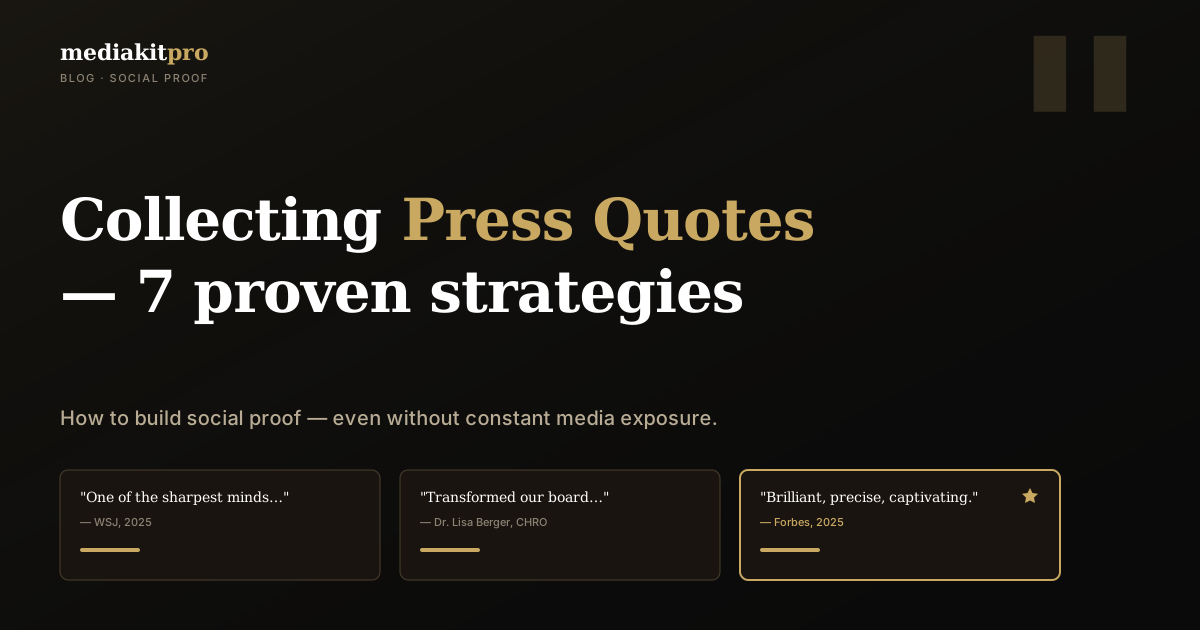
Collecting Press Quotes & Testimonials — 7 Proven Strategies
A media kit without testimonials doesn't sell. But how do you get good quotes if you're not constantly in the media? 7 proven approaches — from elegant client outreach to conference feedback mining.
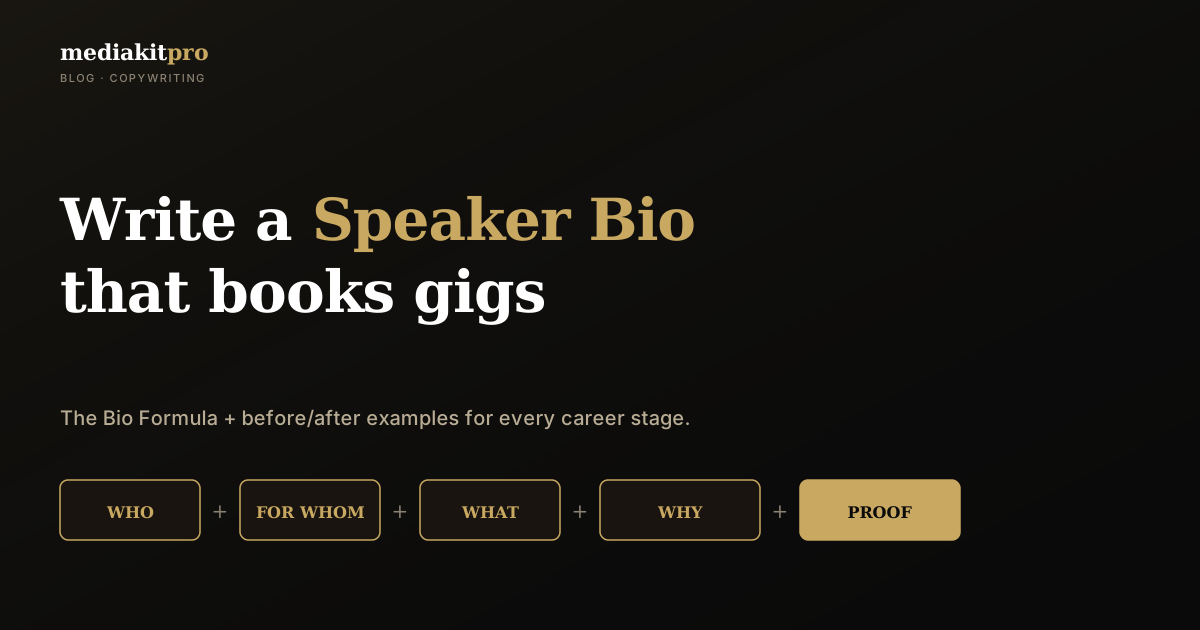
How to Write a Speaker Bio That Books Gigs (Templates Inside)
A strong speaker bio is the most important text in your media kit — and the one most people fumble. Here's the Bio Formula with before/after examples for every career stage.
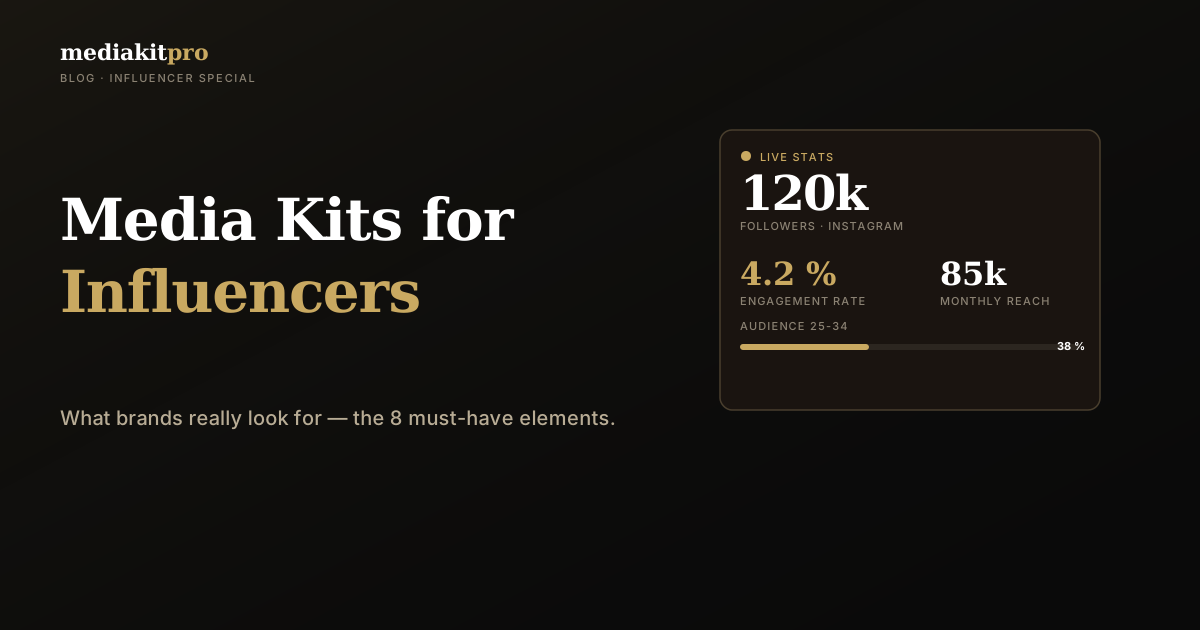
Influencer Media Kits: What Brands Really Look For (2026)
Influencer media kits are a different game: brands evaluate different data than event organizers. The 8 elements that really convince in brand pitches — with examples and best practices.